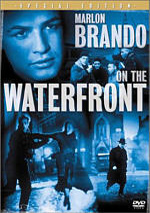
On the Waterfront appears in an aspect ratio of 1.33:1 on this single-sided, double-layered DVD; due to those dimensions, the image has not been enhanced for 16X9 televisions. The picture looked decent for the most part, but it definitely showed its age.
Sharpness generally appeared acceptably distinct and accurate. On some occasions, a little softness crept into the image, but those instances seemed fairly modest. Usually the movie looked reasonably well defined. Some moiré effects and a few jagged edges showed up along the way, but I saw no concerns related to edge enhancement.
Black levels were fairly deep and dense, but contrast occasionally came across as a little problematic. A few scenes appeared too bright, which resulted in a modestly washed-out appearance at times. This wasn’t a consistent problem, though, and most of the movie showed good contrast. Shadow detail was reasonably accurate and displayed nice delineation.
Considering the age of the material, I expected print flaws to provide the most substantial concerns, and this was the case. Light grain cropped up on a consistent basis throughout the movie, and a mix of other defects appeared. I saw white speckles, grit, spots, blotches, nicks, and a few tears. In addition, sometimes the frames jumped slightly. Overall, the image of On the Waterfront appeared acceptable for its age, but it showed a mix of concerns that rendered it average at best.
Somewhat stronger - at least on a relative basis - was the monaural soundtrack of On the Waterfront. Dialogue came across in a manner that was typically thin and flat for the era, but the speech showed fairly good clarity for the most part. I heard no significant edginess, and intelligibility was solid. Effects demonstrated nice distinctiveness and accuracy; though they offered some of the same tinniness found in the dialogue, they also provided reasonable depth.
The film’s score functioned best of all. It also contained some drab tones, but it displayed nice breadth at times. The rhythmic aspects of the music worked best, as drums thumped quite well. I heard no problems related to background noise of any sort; the audio seemed clean. Overall, the soundtrack of On the Waterfront wasn’t anything special but it functioned effectively for a movie of this era.
This DVD release of On the Waterfront tosses in a mix of extras, starting with an audio commentary from Time magazine critic and author Richard Schickel and Elia Kazan biographer Jeff Young. Both men were recorded together for this running, occasionally screen-specific track. I included the latter disclaimer because the two periodically discuss the material on the screen, but they spend most of their time with other topics.
On the negative side, this was a somewhat cacophonous commentary. At times it felt more like two running monologues instead of a discussion between peers. It seemed that each man spent his quiet moments trying to barge back in to the conversation, and the two speak on top of each other quite frequently. They needed a mediator to keep them calm enough to let the other one finish his sentence.
Nonetheless, the information offered in the track seemed very good. Schickel and Young cover a lot of aspects of the production, but they mainly concentrate on interpretation and subtext. Of course, this includes some material about Kazan’s HUAC testimony, but it goes into many other areas as well. Of particular note was a great discussion of Brando’s abilities and issues. Overall, this commentary was somewhat disorganized, but it still added a lot of good material to the table.
Next we find an “exclusive featurette” called Contender: Mastering the Method. This 25-minute and 10-second program largely focuses on the movie’s famous “I coulda been a contender!” sequence. It offers film clips, archival elements and new interview snippets with actors Rod Steiger and Martin Landau as well as a mix of critics and film buffs like Inside the Actor’s Studio host James Lipton, Richard Schickel, Jeff Young, David Garfield, and Patricia Bosworth.
Some may dislike the emphasis on the one scene, but I thought it worked well. It was interesting to get into that snippet so deeply, and “Contender” included a lot of compelling analysis and notes about the film. For the record, some other topics came up as well, but the show really did concentrate mostly on the “contender” scene. Overall, it was a solid little examination of this segment.
Also very good was the Interview with Elia Kazan. The director offered a decent little synopsis of the film’s origins and the production in this 12-minute piece. He proved to be quite frank, as when he referred to producer Sam Spiegel as a “terrible, terrible guy”, and he added a lot of useful information about the film. By this point, some of the material was redundant, but after an audio commentary and a documentary, that was inevitable. The Kazan interview was still informative and useful.
A few minor bits round out Waterfront. A Video Photo Gallery combines filmed still pictures with the movie’s soundtrack; the piece lasts for about four and a half minutes and shows a mix of publicity stills, shots from the set, and posters. We get Filmographies for director Kazan, writer Budd Schulberg, and actors Brando, Karl Malden, Lee J. Cobb, Steiger, and Eva Marie Saint. In the Trailers area we find ads for Waterfront as well as Picnic and Suddenly, Last Summer. Lastly, the DVD’s booklet provides some informative production notes that nicely sum up the project.
On the Waterfront hit movie screens more than half a century ago, but it still maintains quite a lot of power and grit. The film works very well for a number of reasons, but Marlon Brando’s stellar acting remains its calling card. The DVD provides adequate but flawed visuals with audio that seems good for its era and a nice little mix of extras. Overall, On the Waterfront is a DVD that should be pursued by fans of classic films.