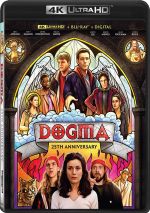
Dogma appears in an aspect ratio of 2.39:1 on this Blu-ray Disc. This became a good but not great presentation.
For the most part, delineation appeared positive. Occasional soft spots emerged but the majority of the movie felt pretty accurate.
No issues with shimmering or jaggies manifested, and I saw no edge haloes. Grain felt appropriate and print flaws remained absent.
With a fairly low-key palette, the colors of Dogma came across as adequate. While they didn’t obviously disappoint, they seemed less than dynamic.
The same went for blacks and shadows, as those elements appeared reasonably positive but not especially strong. I went with a “B” for the image but it leaned toward “B-“ territory.
Downconverted to Dolby TrueHD 7.1, the Dolby Atmos audio of Dogma worked fine for the most part. That said, I thought the remix could feel a bit more aggressive than this story warranted.
Not that the soundscape went crazy. The front channels still dominated and left this as a mix that emphasized music and dialogue.
Nonetheless, I thought this version blasted score too loudly from the back speakers. It also went a little over the top with some effects, though the music became the primary – though modest – distraction.
Audio quality worked fine, with speech that came across as accurate and concise most of the time. A few lines suffered from some edginess but that didn’t turn into much of a concern.
While too prominent in the mix, music still delivered nice range and punch, and outside of a few slightly distorted elements, effects also provided convincing material. I’d prefer a less “in your face” soundtrack for Dogma but still felt the end result seemed more than acceptable.
The Blu-ray provides both new and old extras, and in the former category, we get a circa 2025 introduction from writer/director/actor Kevin Smith (2:17). He offers a hearty endorsement of physical media.
From the old SE DVD, we find two separate audio commentaries, the first of which includes Smith, actors Ben Affleck, Jason Mewes, and Jason Lee, producer Scott Mosier, and View Askew historian Vincent Pereira. All sit together for this running, screen-specific look at story/characters, sets and locations, influences and references, cast and performances, and related filmmaking domains.
As with most Smith commentaries, this becomes a consistently entertaining piece. Smith and Affleck dominate the piece, something that won’t come as a surprise to folks who sat through their Chasing Amy and Mallrats tracks, and the two offer a fun dynamic.
They spend a lot of time cracking on each other, and we find a generally light tone throughout the commentary. Nonetheless, the piece provides a fair amount of information about the production.
Smith and Affleck tend to take the track off-topic pretty easily, and Pereira and Mosier fight desperately to get things back to the subject at hand. They’re not usually not successful, which is why we actually hear some of the guys go over their favorite circa 2000 TV shows and what they’re going to do after the recording session.
Whether they talk about specifics of making Dogma or they banter about various subjects, the end result works. This turns into a loose and funny track that definitely merits a listen.
Note that this track involves “Video Hijinks”, a term that just means “occasional video commentary”. Sporadically during the discussion, we see two-camera footage of the participants as they chat.
This adds virtually nothing to the proceedings. It covers about 32 minutes of the film.
For the second commentary, we hear from Smith, Mosier and Pereira. They sit together for a running, screen-specific “technical track” that examines sets/locations, editing, casting, problems on the set, the film’s budget, photography, and various connected topics.
Despite its title, don’t expect a dry program that focuses on f-stops and aspect ratios. Actually, the guys do touch on aspect ratios since Dogma was Smith’s first scope film, so we hear why he used the 2.35:1 dimensions and why he went with Super 35.
Otherwise, this turns into another fun and generally loose commentary. It may not seem quite as wacky as the “cast and crew” track, but the “technical” commentary still delivers a solid piece.
Note that during both commentaries, you’ll occasionally hear some “bleeps” that cover remarks. These are usually related to Disney, the original backer of Dogma.
Due to contractual obligations, no one was allowed to discuss their participation - or ultimate lack thereof – in the production. That winds up as a minor nuisance during the commentaries since the participants still talk about them but we just can’t hear what they say.
I held out some hope that all these years later, those “contractual obligations” would’ve faded and we’d get “uncensored” commentaries. Nope – the bleeps remain in place.
Deleted Scenes provides 16 different segments. These occupy a total of one hour, 37 minutes, 19 seconds.
Note that you won’t actually find 97 minutes of unused material. For one, most of the clips represent extended versions of existing scenes.
Not all of them elongate bits from the film - one with Bethany at Planned Parenthood is totally new - but for the most part, these are snippets that come with shorter cousins in the movie.
In addition, a lot of the 97 minutes shows introductions from Smith and Pereira. Others occasionally visit them, but it remains their show.
They give us background for the clips and tell us why they didn’t make the cut. Of course, the presentation is fun as always, and these bits help flesh out the details.
As for the unused footage itself, I like the clips. I don’t think that any of them seem tremendously valuable, and I can’t say that I feel the film lost anything without them.
Even the famous “Fat Albert” bit didn’t really belong in the movie. In any case, I like that we get to see this wealth of material, as I always like the opportunity to take a look at the material that didn’t make the cut.
Technical notes: the clips look terrible and got no upgrade for Blu-ray. Perhaps the scenes simply don’t exist in superior resolution but… yikes.
Also, in a perplexing choice, this collection comes with chapter stops but these don’t get timed to take us to each new intro/sequence. Instead, we leap ahead roughly – but not exactly – 10 minutes per break, with literally no rhyme or reason involved.
This makes the compilation tougher to watch if you want to sample the segments. I don’t understand why the disc doesn’t simply line up with each intro, so this version of chapter search becomes borderline useless.
Additional unused shots appear in the Outtakes section (13:07). While some of these provide the usual silly goof-ups, most of them seem more interesting than that.
We get a nice mix of improvisational material and altered clips. Star Wars fans will have a lot of fun, as Smith’s trademark nods to the series pop up all over the outtakes.
In the Storyboards area we find drawings for three different scenes. Created by producer Scott Mosier, we see boards for the “Mooby Sequence” (38 images), the “Triplet Attack Sequence” (79 images), and the “No Man Attack Sequence” (134 images).
The “Mooby” and the “No Man” parts are the most interesting since they included quite a bit of material that didn’t make the film, but all are worth a look. Mosier did a nice job with them.
Note that the disc presents all of these as running montages, not still frames. “Triplet Attack” also shows the final footage in the bottom right of the screen but that presentation doesn’t come with the other two.
Notoriously absent from the 2001 Special Edition DVD, a documentary called Judge Not spans 37 minutes, 20 seconds. It offers notes from Smith, Mewes, Affleck, Mosier, Lee, author/pastor Dr. Kenneth Stevenson, and actors Matt Damon, Alan Rickman, Chris Rock, and Salma Hayek.
“Judge” examines the movie’s roots and development, Biblical elements and how Dogma treats them, the controversies that greeted the film and related issues.
This becomes a one-sided look at the project. Not that I think the anti-Dogma people enjoyed credibility, but nonetheless, the participants all support the project unilaterally so we don’t get anything objective.
Some good notes still emerge. However, “Judge” mostly feels like Smith as Oppressed Victim, a trend that got worse over the years.
Note that the opening to “Judge” tells us to go to viewaskew.com for more detail about the Dogma production and an explanation of all the “bleeped” content. Don’t try this at home, as though the site remains in existence, I only found dead links when I explored the Dogma material.
Various odds and ends flesh out the disc and we get plenty of ads. In addition to new “25th Anniversary” teaser and trailer, we find the movie’s original trailer, a UK teaser, a US TV spot and two UK TV spots.
“Original PSP Introduction“ (2:01) offers a discussion of the film’s PlayStation Portable version – sort of, as Smith mostly rambles about whatever occurs to him. It’s interesting for historical purposes.
Next comes “ShoWest Sizzle”, a 49-second clip created to sell the movie to exhibitors. Like “PSP”, it becomes an archival curiosity, though it promotes Dwight Ewell – who barely appears in the movie – as a major part of the cast and claims Emma Thompson will play God.
Mewes and Smith show up for the “Jay and Silent Bob’s Secret Stash” promo (1:34), though not in character. Yes, it’s shamelessly promotional, but it’s an entertaining 94 seconds, so I won’t complain.
By the way, though this ad got shot a quarter of a century ago, the store still exists, though not in precisely the same location. While at 35 Broad Street in Red Bank NJ then, it now resides at 65 Broad Street. Not sure if the newer place is bigger or smaller.
A few more oddities pop up, and “My Opinion By Mrs. Helen Wise” fills four minutes, 14 seconds. Here you can watch random bits of complaining from “Mrs. Wise” about the film. They give us a funny addition to the set.
Two Easter Eggs from the SE DVD finish the disc. We find “How Jay Thinks Kevin Directs” (1:58) and “How Kevin Directs”. (2:14).
Both of these involve Smith and Mewes as they use Jay and Silent Bob action figures to recreate their vibe on the set. They offer amusement.
By no stretch of the imagination could I view Dogma as a great film. Nonetheless, it becomes witty and provocative. The Blu-ray comes with largely positive picture and audio as well as a strong roster of bonus materials. Despite its inconsistency, Dogma remains an entertaining effort.
Note that this Blu-ray only comes paired with the movie’s 4K UHD version. Lionsgate chose not to release a solo Blu-ray for Dogma.
This means Blu-ray fans without 4K UHD players will need to buy this package to get the movie’s BD – well, unless they want to locate the long-out-of-print Blu-ray from 2008. Given how scarce and pricey that one is, BD fans without UHD players seem more likely to want to get this set.
Note that the 4K disc comes with some supplements not includes on this BD. Those will come up for discussion in the UHD-specific review but since this one focuses solely on the BD, I didn’t think it made sense to get into them here.