Mortal Kombat: Annihilation appears in an aspect ratio of approximately 1.85:1 on this 4K UHD Disc. Despite basic issues with the source, the Dolby Vision image largely satisfied.
Annihilation came with lots of green screen and effects shots, and those inevitably led to degradation of sharpness. Still, although softness could pop up at times, the movie boasted fairly good delineation most of the way.
No issues with jagged edges or moiré effects materialized, and I saw no edge haloes. Grain seemed appropriate and I found no print flaws.
The movie went with a fairly stylized palette that pushed toward blues, greens, reds and purples dependent on the setting. These looked fairly rich, with an extra layer of impact from HDR.
Blacks seemed fairly deep and dense, while shadows came across as well-depicted. HDR gave added punch to whites and contrast. Given the nature of the project, the presentation worked pretty well.
In addition, the film’s DTS-HD MA 5.1 soundtrack seemed even better. With nearly non-stop action, the flick came with a loud mix that used the various channels in a satisfactory manner.
Music formed an aggressive part of the track, and lots of effects cropped up from the rear and side speakers as well. These added extra kick to the action and delivered a good sense of the environment.
Audio quality was fine. Again, this was a loud track – maybe a little too loud, to be honest, but reproduction seemed positive.
Speech was reasonably concise, and music showed good punch and range. Effects were strong and powerful, with nice low-end. The track suited the movie.
How did the 4K UHD compare to the 2011 Blu-ray version? Both came with seemingly identical soundtracks.
On the other hand, the UHD’s Dolby Vision image looked better defined and more vibrant than the BD. Even with the limitations of the source, the UHD turned into a clear visual upgrade.
Almost no extras appeared on the 2011 release but this Arrow package comes with a mix, and it starts with two separate audio commentaries. The first comes from director John R. Leonetti and moderator Gillian Wallace Horvat, both of whom sit together for a running, screen-specific look at story/characters, sets and locations, Leonetti’s shift to the director’s chair, photography and visual design, stunts, effects, cast/performances and music.
That means we get a quality overview of the production. Horvat asks good questions and Leonetti provides a high level of information in this strong chat.
For the second commentary, we hear from comic book expert Dave Baxter. During his running, screen-specific piece, he talks about the source video games, their characters and evolution, and comparisons with the movie versions.
Baxter’s track for the 1995 movie took a broader focus and I feel happy he doesn’t try to simply recap what he said there. Baxter breaks down the history of the Kombat characters well and turns this into another worthwhile discussion,
Video programs ensue and The Queen of the Night goes for 18 minutes, 29 seconds. This one involves actor Musetta Vander.
She discusses her life/career as well as aspects of her time on Annihilation. Vander provides an appealing collection of memories.
Techno, Taiko, Orcho lasts 16 minutes, 21 seconds. The reel brings notes from composer George S. Clinton.
Unsurprisingly, Clinton looks at how he got into movies along with his scores for the Mortal Kombat flicks. This turns into another useful chat.
Next comes The Man of a Thousand Deaths. During the 19-minute, 56-second program, we hear from stunt performer JJ Perry.
"Deaths" covers Perry's early interest in martial arts and how he came to movies plus his actions on the Kombat movies. Perry covers these areas well.
Behind the Scenes spans 14 minutes, 34 seconds and delivers raw footage from the production., I enjoy this form of material and this winds up as a nice compilation.
With On-Set Soundbites, we get comments from Leonetti (0:53), producer Lawrence Kasanoff (0:59), and actors Irina Pantaeva (0:39), Lynn "Red" Williams (1:17), Sandra Hess (1:18), Talisa Soto (1:02) and Robin Shou (1:14). Little of substance arises, and given the brevity of the snippets, the absence of a "Play All" option annoys.
Along with the film's trailer and three TV spots, the disc concludes with an Image Gallery that brings 663 screens of concept art, ads, movie stills and behind the scenes shots. I find a lot to like here but the compilation would feel more user friendly if it broke into multiple subdomains.
Because Mortal Kombat offered a dud, its sibling flick Annihilation couldn’t fall very far. Despite a few good fight scenes, Annihilation turns into an awful film. The 4K UHD provides pretty solid picture and audio but suffers from erratic visuals as well as a mix of supplements. This becomes a good release for a bad movie.
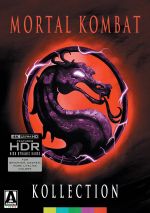
Note that as of May 2026, this Arrow 4K UHD version of Mortal Kombat Annihilatoin comes only as part of a two-film “Mortal Kombat Kollection”. It also includes 1995’s Mortal Kombat.