|
ALLIANCE
|
| |
|
MOVIE INFO
|
Director:
Quentin Tarantino
Cast:
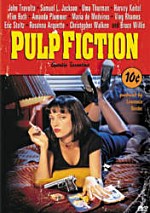
John Travolta, Samuel L. Jackson, Uma Thurman, Harvey Keitel, Tim Roth, Amanda Plummer, Maria de Medeiros, Ving Rhames, Eric Stoltz, Rosanna Arquette, Christopher Walken, Bruce Willis, Quentin Tarantino
Screenplay:
Quentin Tarantino based on stories by Quentin Tarantino and Roger Avary
Tagline:
You won't know the facts until you've seen the fiction.
MPAA:
Rated R.
Academy Awards:
Won for Best Screenplay.
Nominated for Best Picture; Best Director; Best Actor-John Travolta; Best Supporting Actor-Samuel L. Jackson; Best Supporting Actress-Uma Thurman; Best Film Editing.
| |
|
DVD DETAILS
|
Presentation:
Widescreen 2.35:1
Audio:
English Dolby Digital 5.1
French Dolby Surround
Subtitles:
None
Closed-captioned
Runtime: 154 min.
Price: CAD$39.95
Release Date: 12/8/1998
Bonus:
• Deleted Scenes introducted by Quentin Tarantino
• Theatrical Trailers
| |
|
EQUIPMENT
|
Sony 36" WEGA KV-36FS12 Monitor; Sony DA333ES Processor/Receiver; Panasonic CV-50 DVD Player using component outputs; Michael Green Revolution Cinema 6i Speakers (all five); Sony SA-WM40 Subwoofer.
| |
[an error occurred while processing this directive]
|
Pulp Fiction: Canadian Alliance Edition (1994)
|
|
Reviewed by Colin Jacobson
Regular readers may have already observed my periodic rants against the voting tendencies of the Academy of Motion Picture Arts and Sciences. I'll skip my usual tirade here other than to point out one particularly telling misstep made by Oscar: the near-total shutout experienced by Pulp Fiction at the 1995 awards.
While I frequently disagree with the Academy's picks, that year's ceremony seemed particularly political. The battle mainly raged between Pulp, a profane, violent and tremendously thrilling movie that actually managed to seem new and fresh - something we don't see frequently - and Forrest Gump, an entertaining but fairly conventional and sentimental film.
As they consistently cast their votes for Gump and left Pulp out in the cold, it seemed clear that the Academy made a statement with their votes. Down with young, hip and potentially offensive; up with clean, stale and acceptable for all audiences. Pulp won only one of its seven nominated categories, that of Best Screenplay Written Directly for the Screen; Gump came from an already-existing novel or it would have trumped Pulp there as well, I'm sure.
No offense to Gump, because it really is a decent little film once you separate it from all its hype, but it doesn't even remotely compare to Pulp as a movie. Gump was a pleasant picture that achieved its modest goals and made a lot of people happy. Pulp, on the other hand, set screens on fire and proved to be one of the most influential films of the Nineties.
I guess "slow and steady wins the race" with Oscar, though, since they chose to take the path of least resistance. It looked like a wimpy move seven years ago and I don't think time will alter that opinion, since Pulp doesn't look to become any less scintillating any time soon.
Pulp provides a non-linear series of vignettes framed by a robbery staged at a coffee shop. In the first, hood Vincent Vega (John Travolta) must take Mia (Uma Thurman), the wife of his boss Marsellus Wallace (Ving Rhames), out for a night on the town. After a fun time at a hipster restaurant, things take a dark turn when Mia overdoses on heroin she mistakes for cocaine, and Vincent must revive her.
Called “The Gold Watch”, the second segment concentrates on over-the-hill boxer Butch Coolidge (Bruce Willis). Ordered by Marsellus Wallace to throw a fight, instead Butch wins and kills the other boxer in the process. After word got out that the fix was in and odds greatly favored the other fighter, Butch put down his own bets on himself via an agent, so he stands to make a financial killing if he can escape the wrath of Marsellus.
However, Butch’s flighty French companion Fabienne (Maria de Medeiros) forgets to bring a family heirloom - the titular timepiece - with her, so Butch must take his chances with a visit to their apartment. There he manages to regain the watch and kill the thug waiting for him, but on the way back to his motel, he coincidentally encounters Marsellus on the street. After an altercation, the pair end up in a pawnshop where they get held as captives by some freaks who plan to rape them.
Lastly, “The Bonnie Situation” returns us to the characters from the first story, Vincent and partner Jules Winnfield (Samuel L. Jackson). After Vincent accidentally blasts off the head of a captive, they need to quickly deal with the bloody car, and they pull into the house of associate Jimmy (Quentin Tarantino). There they call Marsellus, who sends Winston Wolf (Harvey Keitel), a man who takes care of problems. After he deals with this issue, Vincent and Jules discuss the latter’s feelings that they encountered a miracle back during their job. Although a punk fired at them at very close range with a very large gun, they escaped without a scratch, and Jules considers the theological ramifications of the event. They have this chat at the diner featured early in the movie, which brings Pulp back home.
By no means is Pulp a perfect film. Really, the movie's main fault is the somewhat weak second act, aka the Bruce Willis section. This is no slight on Willis, especially since he provides some of his best work in this film. "The Gold Watch" actually works pretty well, but "Vincent Vega and Marsellus Wallace's Wife” is so good that it's an incredibly hard act to follow. Logically, director Tarantino opts for a second act that goes at a different pace from the edgy, retro-hip attitude of "Vega", so “Watch” moves a bit more slowly. I like "Watch" but it's undeniably the weakest of the three segments.
"The Bonnie Situation" helps recapture the magic of the initial segment, though it also isn't quite up to the highs of "Vega". To be frank, though, I'm nitpicking, because what's mediocre in Pulp would be outstanding in another film. This is moviemaking of the highest order, a thoroughly invigorating and exciting film that remains compelling even at its worst.
A lot of this is due to the fine acting we see. John Travolta resurrected his career through his part as Vega, and he couldn't have done so in finer style. He plays the part with style and aplomb. Samuel L. Jackson's his usual outstanding self; that neither he nor Travolta won the Oscars for which they were nominated remains a crime. Some controversy accompanied the fact that Travolta got a Best Actor nod while Jackson only was considered for Best Supporting Actor. Really, the film contains no lead characters, so Travolta should have been in the supporting area as well, but he does seem to have the character with the most screen time. Vega's also the only one of the "main" characters who appears in all three vignettes.
I also really liked the work from Uma Thurman. I think she doesn't receive a lot of credit as an actress because she has something of a bimbo model look to her, but she actually can perform well, and she does a great job here as Mia Wallace. Thurman manages to convey a wide variety of attitudes and emotions in the role and has never been better.
Tarantino goes out on a limb with many unusual stylistic choices, including the chronological variances that confused some audience members; I know because I heard them muttering during screenings. However, Tarantino makes it all hold together impeccably. The film is confusing if you sit back and try to cruise through it; you will have to think at times to keep it together, but with a modicum of intellect, it'll all make perfect sense.
One secondhand personal note: my friend Kevin's a flight attendant and he once had Amanda Plummer - who plays Honey Bunny - on a trip. He delights in telling how pushy and obnoxious she was and likes to call her "Demanda Plummer." Unfortunately, when pressed, Kevin will admit this is completely untrue; apparently Plummer seemed quite delightful and lovely and displayed no overbearing behavior. Kevin just wishes she acted untowardly because he's so fond of the name. However, it should be noted that apparently Plummer's "assistant" was a jerk, according to Kevin.
I won't call Pulp Fiction the best movie of the Nineties - I'd still pick Se7en for that honor - but it's way up there. It's a film that belongs somewhere in everyone's collection.
|
The DVD Grades: Picture C / Audio C+ / Bonus C-
|
|
Pulp Fiction appears in its original theatrical aspect ratio of 2.35:1 on this single-sided, dual-layered DVD; the image has not been enhanced for 16X9 televisions. Due to a number of concerns, this picture seemed mediocre at best.
Sharpness appeared adequate but unspectacular. The image usually looked reasonably accurate and well-defined, though a fair amount of softness interfered with the presentation. The picture rarely seemed really fuzzy, but it also didn’t come across as terribly detailed much of the time. Jagged edges created some noticeable problems, and I also noticed quite a lot of moiré effects. The shots in the coffee shop caused the heaviest concerns, mainly due to the blinds behind Amanda Plummer and Tim Roth; those shimmered badly at times. In addition, I saw some moderate edge enhancement and a mix of mild print flaws. Light grain showed up during parts of the film, and some speckling also occurred at times. In addition, the image wobbled on occasion and tended to flicker periodically.
Much of the time, colors looked nicely rich and vivid. However, the film also took on a pale and flat appearance during many sequences. The image tended to seem somewhat overblown and washed out at times. Black levels came across reasonably well, though they sometimes looked a bit gray. Shadow detail tended to be slightly too heavy; some scenes were overly opaque, though not frightfully so. Overall, enough of the image looked good to merit a “C” grade, but too many flaws appeared to earn anything above that mark.
Pulp Fiction featured a pretty blah but acceptable Dolby Digital 5.1 mix. It's really quite a tame track, with a nearly monaural presence at times. Still, it used the front soundstage pretty well, with a decently broad image; the audio stuck largely to the center but could spread out across the two side channels to offer acceptably involving sound. The mix mainly ignored the surrounds, though. I noticed exactly one example of split surround usage - when a car drives from front left to rear left - and the rears generally provided very mild ambience at best. Nonetheless, I can't really quibble with the activity level of the mix; while it could have used a little more life, this is such a dialogue-intensive picture that I understand Tarantino's desire to keep the focus firmly up front.
As far as quality went, Pulp seemed decent at best. Dialogue appeared easily intelligible and clear, but the lines sometimes appeared a bit flat and dull; the speech should have come across as more lifelike than it does. Those parts also displayed quite a lot of edginess and brittle qualities at times. Music usually sounded fairly good, though the songs lacked much depth; bass response for the music seemed weak. A bit of distortion could be heard during some songs, but those problems appeared inherent to the original recordings; the issue only occurred during the oldest songs. Gunfire also could seem slightly distorted, but not badly, and effects generally appeared relatively realistic and packed a modest bass punch. Overall, the track worked acceptably well, but its lack of scope and some periodically shrill and harsh sound meant the audio of Pulp Fiction deserved nothing higher than a “C+”.
One audio note: at right about the 104 minute mark, the music dropped out of the front left speaker and stayed absent for about one minute. This is not a problem reserved for this DVD; I checked the same spot on my Criterion laserdisc and the same thing happened there. I didn't remember it, so it freaked me out a bit, but rest assured that it's a problem with the program, not with the DVD itself.
While this edition of Pulp Fiction doesn't really count as a special edition, it does provide a few supplements that are missing from the original American release. Most significant are four deleted scenes. These come with introductions from Tarantino, and the whole package lasts for about 19 and a half minutes. These segments are all essentially longer versions of existing scenes and are definitely interesting; Tarantino probably should have kept some of them.
We also get five trailers for the film, each from a different country: US, Japan, UK, Germany and France. The Japanese clip is the only one that differs significantly from the others; it sticks with the same basic formula but offers some different scenes and shows some more graphic violence and language. (The narrator also refers to "Ving Ramos" and "Yuma Thurman", which entertained me.)
The other four stick with the same framework but make some minor alterations. The US version removes foul language; it cuts out "nigger" and excises the profane part of "Die you motherfuckers!" whereas the other clips keep it. The UK piece simply shortens the ad, while the German version dubs it into the native language, the only one of the three non-English countries that does so; Japan and France offer subtitles.
I have to say that in any version - but mainly the US one, which is the edition I saw when the film arrived back in 1994 - it's a hell of a trailer. It does an amazing job of selling the movie and makes it look tremendously sharp, clever and exciting. All of which are true, of course, but I just thought the trailer deserved special mention; I watched it right after I viewed the movie, and the ad made me want to watch the flick again!
Which I'll do in due time, and I'll watch it again and again. I've seen Pulp Fiction about ten times now, and it has yet to lose any of its luster or appeal; the movie seems destined to stand as one of the best films of the Nineties, and probably of all-time. Unfortunately, the DVD suffers from a mix of concerns. Picture and audio quality seem erratic and appear mediocre at best, and the package includes only a few extras.
For a few years, this Canadian set from Alliance offered the strongest version of Pulp on DVD, at least in Region One. However, now that we have a new special edition release of Pulp, this old one becomes disposable. The 2-DVD set provides stronger picture and sound as well as many more supplements. I strongly recommend Pulp Fiction, but I can’t advise anyone to buy this Alliance edition with the new package now on the shelves - it thoroughly trumps the older releases.
To rate this film visit PULP FICTION: Collector's Edition.
|
|