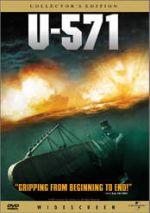
U-571 appears in an aspect ratio of approximately 2.35:1 on this
single-sided, double-layered DVD; the image has been enhanced for 16X9
televisions. While it shows a few minor problems, for the most part I
thought the picture looked terrific.
Sharpness seemed clean and accurate, with virtually no examples of softness
to be found. A lot of the film could easily become muddy and murky -
especially all of those underwater shots - but the movie stayed crisp and
detailed at all times. Moiré effects and jagged edges seemed absent, and I
detected only a few examples of artifacts from the 16X9 downconversion on my
4X3 TV. As for print flaws, I witnessed a couple of white speckles and a
few bits of black grit but no more substantial problems; overall, it was a
clean film.
U-571 utilizes an extremely limited palette for the most part; after
all, subs aren't hot-spots for bright and varied colors. In any case, I
found the hues to appear clear and tight with no concerns related to
bleeding or noise. Actually, the best example of the colors' tightness came
during the opening scene; when the movie starts, the German sailors are
bathed in red light. Crimson lighting often causes problems on TVs and
easily can look mucky, but that wasn't the case here; I saw some of the
clearest red shading I've detected on my TV.
Black levels appeared nicely deep and dark, and I witnessed very solid
contrast throughout the movie. Shadow detail seemed appropriately heavy and
but lacked any excessive thickness or muddiness. Ultimately, I thought
U-571 presented a very attractive and crisp picture.
Even better is the movie's soundtrack. Make that soundtracks, since
U-571 includes both Dolby Digital 5.1 and DTS 5.1 mixes. Although
both seemed pretty similar, I preferred the DTS track overall. As such, all
of my initial comments will discuss the DTS version and I'll then provide an
extra paragraph that describes any differences I detected in the DD track.
The soundfield of U-571 appeared extremely involving and engaging.
All five speakers worked overtime as they provided a clean and well-blended
audio environment. Each channel displayed a great deal of unique sound, and
all of it came together smoothly; audio transitioned between speakers in a
clear and accurate manner that brought the movie to life. There's so much
great sound here that it's hard to pick a special example, but I think I
liked the first "torpedo attack" sequence best; the way that the torpedoes
fly past us seemed especially exciting.
Audio quality also appeared solid. During an early ballroom scene, I heard
some mild edginess to the dialogue, but otherwise speech was natural and
articulate; I had trouble understanding lines at times because of the noise
level from the rest of the track, but this did not seem to involve any lack
of intelligibility from the dialogue itself.
Music sounded wonderfully bright and crisp, as the scored displayed strongly
brassy and rich tones. Effects were terrifically realistic and bold. They
displayed no signs of distortion and offered a great deal of bass; the
impact of the explosions will really hit home. Overall, the DTS mix of
U-571 seemed immensely active and very clean and powerful.
How does the Dolby Digital 5.1 track differ? I thought it showed small but
noticeable decreases in quality. The soundfield for the DTS mix blended
more seamlessly; it presented a more inclusive and enveloping experience.
The DD track came across as slightly more "speaker-specific"; sounds
appeared more heavily based within the various channels and didn't come
across as realistically placed. I also thought the bass response was
somewhat less strong, as the low-end didn't pack quite the same punch. As a
whole, the Dolby Digital mix worked very well on its own; however, I thought
the DTS track simply provided more effective audio.
U-571 is billed as a "Collector's Edition"; as such, it includes a
few different supplemental features. First up is an audio commentary from
director/writer Jonathan Mostow. He provides a fairly solid track that
offers some solid and interesting information about the film. Mostow covers
a wide variety of topics, from historical issues to concerns faced by the
actors to technical areas. The commentary suffers from only a few empty
spots as Mostow offers a consistently chatty and involving presence.
Overall, the track seems unspectacular but enjoyable.
U-571 provides a slew of different video programs as well. The first
is the worst: Spotlight On Location, a thirteen-minute and 25-second puff
piece about the movie. This show gives us interview snippets from director
Mostow and a few cast members in addition to many scenes from the film and
some production shots. The emphasis is wholly promotional as this program
gives us little detail about how the movie was made; Mostow gives us some
decent notes about his interest in the project, but after that the show
becomes completely oriented toward telling us how great the movie is.
U-571 itself isn't bad, but this documentary is pretty flat.
By the way, if you have any doubt that U-571 is a rah-rah "let's go
USA" film, then I must point out one of the oddest "extras" I've seen on a
DVD. After the end of "Spotlight On Location", we find an ad for the Navy.
I guess they're hoping the adrenaline-pumping action will spur some
impetuous enlistments.
A little better is Creating and Constructing U-571, a six minute
and five second featurette about the technical effects in the film. As you
can figure from the brevity of the show, we don't get much detail about the
various elements but it's not a bad little piece. We hear from both
technical crew members and a few actors who discuss their experiences on the
film. The program's nothing special, but it's worth a look.
More interesting is Inside The Enigma, a seven minute program that mainly
features cryptologist David Kahn. He discusses the history of the German
"Enigma" encoder plus its use in WWII. It's a nice little view of the facts
behind the device.
Additional historical information can be found in Britain Captures the
U-110. In this nine minute and 40 second show, Mostow interviews Lt.
Commander David Balme, a British WWII veteran who also worked as "historical
advisor" on the film. Balme offers a lot of great information about the
successful capture of an Enigma device by the British. The program combines
this interview material with some great historical footage and photos.
Similar information can be found in A Submariner's WWII Experience. This
seven minute and 50 second piece includes another Mostow interview, this
time with Vice Admiral Patrick Hannifin. The WWII veteran - who also was
"technical advisor" for the movie - discusses his experiences during the war
and gives a short but solid overview of the entire experience. It's an
interesting and valuable program.
The final video piece is a newsreel from the mid-Forties. Called US Naval
Archives: Capturing the U-505, this films lasts for two minutes and 50
seconds and it shows footage of the event in question. I love this kind of
historical information, and I appreciated its inclusion here.
Some more typical extras appear as well. We get the theatrical trailer for
U-571. Additional promos can be found in the "Recommendations" area;
in that section, we find trailers for EdTV and Pitch Black.
The DVD includes text Production Notes that are surprisingly lengthy and
detailed. Even though I learned a lot about the project from the audio
commentary, these notes add a great deal of information and provide a strong
general chronology and overview.
Cast and Filmmakers includes fairly basic but moderately interesting
biographies. We get listings for 10 actors (Matthew McConaughey, Bill
Paxton, Harvey Keitel, Jon Bon Jovi, Jake Weber, David Keith, Matthew
Settle, Thomas Kretschmann, and Erik Palladino) plus director Mostow.
In addition to all these features, we get additional materials in the
DVD-ROM area. This domain adds more biographies; in addition to the same
listings we found on the "regular" parts of the DVD, entries for six more
actors (Jack Noseworthy, TC Carson, Thomas Guiry, David Power, Will Estes,
Derk Cheetwood) and 12 crew members (co-writers David Ayer and Sam
Montgomery, producers Dino De Laurentis, Martha De Laurentis, and Hal
Lieberman, cinematographer Oliver Wood, production designers William Ladd
Skinner and Gotz Weidner, editor Wayne Wahrman, line producer Lucio
Trentini, costume designer April Ferry, and composer Richard Marvin).
"Below the Deck" reproduces the same "Production Notes" found elsewhere,
while "Reconnaissance" includes 10 production photos. "Historical Specs:
The Submarines of WWII" offers brief text notes about five German and five
US subs. Finally, the DVD-ROM area provides links to: Universal DVD
Newsletter; Universal DVD; Universal Home Video; Universal Pictures; and
Universal Studios.
Although U-571 doesn't become a terribly memorable film, it still provides
enough thrills and excitement to make it worthwhile. The story never rises
above hoary war flick clichés and the action isn't presented with much
flair, but the overall package seems just interesting enough to stimulate my
attention. It helps that the DVD itself is pretty terrific. Both picture
and sound are excellent - especially if you can play the DTS mix - and the
disc contains a few solid extras as well. Those who enjoy war movies will
probably get a kick out of U-571.
To rate this film visit the Blu-ray review of the U-571